Watershed moment: Indiana's bishops release pastoral letter on 'integral ecology'
Victoria Arthur, ICC Correspondent
Representing all corners of a state abundant with intricate waterways and varied landscapes, the five bishops of Indiana have released a new pastoral letter highlighting the profound connection between the natural world and human life.
In their new document, “Integral Ecology: A Sacramental Vision,” these five bishops of the Indiana Catholic Conference (ICC) also call for a renewed sense of responsibility for protecting God's creation.
“The concept of integral ecology helps us see more clearly how human life and the natural world are deeply interconnected,” said Archbishop Charles C. Thompson of the Archdiocese of Indianapolis. “Here in Indiana, we delight in the beauty of creation from our Great Lake and winding rivers to forests, prairies, wetlands and farmland. As people at home in this land and pilgrims journeying toward our true home in heaven, we are called to receive creation as a gift and to care for it with gratitude and hope.”
Written during the 2025 Jubilee Year of Hope, the letter — which was released on Holy Thursday, April 2 — is addressed to “brothers and sisters in Christ and all people of good will in the state of Indiana.” It is signed by Archbishop Thompson and the other four bishops of Indiana: Bishop Kevin C. Rhoades of the Diocese of Fort Wayne-South Bend, Bishop Robert J. McClory of the Diocese of Gary, Bishop Timothy L. Doherty of the Diocese of Lafayette-in-Indiana, and Bishop Joseph M. Siegel of the Diocese of Evansville.
“Integral Ecology: A Sacramental Vision” reflects on the social and ecological challenges of the current age and the link between caring for the earth and caring for humanity, particularly the most vulnerable. It also builds upon the bishops’ previous teaching on stewardship of creation, including their pastoral letters “Care for the Earth,” issued during the Great Jubilee of the Year 2000, and “Poverty at the Crossroads,” released in 2015.
“This is a groundbreaking new statement from the bishops of Indiana,” said Alexander Mingus, executive director of the ICC, the statewide coordinating body for the five Roman Catholic Dioceses in Indiana. “It is an invitation to a deeper, faith-filled understanding of humanity’s relationship with creation — one that recognizes the world as a gift from God and calls for responsible stewardship rooted in the sacramental life of the Church. We hope that it has a profound and lasting impact throughout our beautiful state and beyond.”
In publishing and disseminating the new letter, the ICC has partnered with Our Sunday Visitor (OSV), the Huntington, Ind.-based company that is one of the largest Catholic publishers in the world. The print version of the full document, along with a one-page summary, will be made available through OSV to parishes, schools and other audiences.
A digital version of the pastoral letter, in addition to related resources, is also available through the ICC website at indianacc.org/ecology.
Archbishop Shelton J. Fabre of the Archdiocese of Louisville, who serves as chairman of the U.S. Conference of Catholic Bishops (USCCB) Committee on Domestic Justice and Human Development, recognized the work of the Indiana bishops on this pastoral letter. The committee’s mandate to “advance the social mission of the Church” includes education on issues covered in the letter.
“I commend the Indiana bishops for this authentic reflection on God's creation and the people of Indiana, especially the poor and vulnerable,” Archbishop Fabre said. “In this season of hope and renewal, the call to action and inspiring examples of resilience bring Good News for all to hear.”
Bishop Rhoades of the Diocese of Fort Wayne-South Bend said that he and his brother bishops drew on the Church’s long history of teaching about the “sacramental vision of creation” in developing the letter.
“I highly recommend the reading and study of this pastoral letter from the bishops of Indiana, a reflection of the Church's teaching on integral ecology applied to the environmental conditions in our state,” said Bishop Rhoades, who serves as secretary of the USCCB. “The ecological crisis has human, ethical and spiritual dimensions since God is the creator and has entrusted us with the care of his good creation, requiring, as the Catechism teaches, ‘a religious respect for the integrity of creation.’
“Our Catholic sacramental vision of creation views nature as a manifestation of God's presence and as intimately connected to the protection of human life and dignity,” continued Bishop Rhoades. “I hope that the faithful will find this pastoral letter not only informative, but also helpful in promoting and living out the 'ecological conversion' called for by Popes John Paul II, Benedict XVI, Francis, and Leo XIV.”
The genesis of the pastoral letter was a conversation a decade ago between Bishop Rhoades and Father Terrence (Terry) Ehrman, C.S.C., a professor at the University of Notre Dame whose primary academic interest is the study of the relationship between theology and science. Their discussion occurred not long after Pope Francis issued his influential encyclical “Laudato Si': On Care for Our Common Home,” which had drawn the world's attention to environmental issues.
Father Ehrman had already done extensive research on watersheds — areas of land where all precipitation drains into a common body of water, such as a river, lake or ocean. He told Bishop Rhoades about a pastoral letter that 12 Catholic bishops from the Pacific Northwest and British Columbia had written in 2001 about the Columbia River Watershed in that area, drawing attention to the pollution that was plaguing it and calling for regional cooperation to refresh and protect it.
During that conversation on the Notre Dame campus, Father Ehrman made a suggestion that would have ripple effects. He told Bishop Rhoades he would one day like to see the bishops of the Great Lakes collaborate on a similar letter concerning the Great Lakes Watershed, whose five interconnected lakes comprise the largest freshwater system on earth.
Bishop Rhoades was intrigued and brought the idea to his fellow Indiana bishops. While that larger multi-state effort has yet to occur, plans began to take shape for a pastoral letter based on the ecology of the Hoosier state, including the one Great Lake that borders it.
Father Ehrman became the bishops' primary advisor and collaborator on the letter, whose content closely reflects the “Theology and Ecology” course he has taught at Notre Dame since 2012.
“Indiana is an amazing place,” said the self-proclaimed adopted Hoosier, a Baltimore native who is a priest of the Congregation of Holy Cross. “It's the smallest of the continental states that are west of the Appalachian Mountains, but it's a top-10 agricultural producer and has so many beautiful natural features, from the Indiana Dunes to the north on Lake Michigan to the Ohio River to the south.”
The study and symbolism of water figures prominently in Father Ehrman's classes, in Sacred Scripture — and in the bishops' Integral Ecology pastoral letter.
“Water gives life and renews and refreshes,” the letter reads, citing the waters of baptism that bring the faithful to new life in Jesus Christ and calling on all citizens to protect this critical resource that God has entrusted to them.
“Sadly, our state of Indiana, with its 63,000 miles of streams and rivers and inland lakes and reservoirs, has some of the most polluted water in the country,” the bishops state in their letter.
The letter also points to the loss of biodiversity that has resulted from the state's dramatic loss of wetlands over the last century or more. While wetlands once covered nearly 25 percent of the state of Indiana, less than 1 percent now remains.
In his classes at Notre Dame, Father Ehrman tries to instill in his students that everything is connected. When wetlands disappear, so do a multitude of plants and animals — ultimately affecting humans too.
“There is an ecological citizenship that we belong to,” he said. “We don't just live at a street address. We're part of an ecosystem that has other organisms in it, and there's water flowing, and it's an element of a larger, complex system. In the same way, we're members of a parish, which is part of a diocese, which is part of the Catholic Church as a whole.”
This convergence of the physical world and the spiritual realm is reflected in the images that illustrate the Integral Ecology pastoral letter.
Father Ehrman supplied nearly all the photographs to accompany the letter, from images of Indiana's natural resources to artwork representing all five of the state's cathedrals. A stained-glass window from Lafayette's Cathedral of St. Mary of the Immaculate Conception, for example, depicts a scene from the Biblical story of Noah's Ark.
“One of the most powerful aspects of the pastoral letter is the imagery from churches and sacred art,” Mingus said. “These visuals help to reinvigorate our ability to contemplate God in the natural world, in its beauty and order which reflects the characteristics of the creator.”
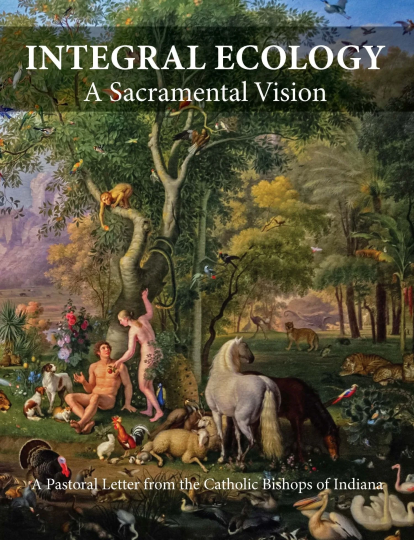
The story of creation itself is the subject of the cover art for the pastoral letter. “Adam and Eve in the Garden of Eden,” an early-19th-century painting by Czech artist Johann Wenzel Peter, was the image selected to set the tone for the bishops’ message.
The painting represents the harmony that God intended for this world from the beginning.
“This powerful image depicts the Garden of Eden in which, before the Fall, we find right relationship between God, ourselves, and creation,” Mingus said. “Restoring right relationship is the essence of this pastoral letter.”
Ultimately, the hope of the bishops and everyone involved with the pastoral letter is a renewed sense of wonder and responsibility for the natural world at a time when technology consumes so much of people's time and focus.
“One of the best ways we can encounter God is through creation,” Father Ehrman said. “But we'd rather be on our cell phones, our laptops and our video games. How can we get back to seeing with this sacramental vision?
“Every day, every moment becomes an opportunity to encounter God — not just at church on Sunday,” he continued. “Everything around us, everything that's created is an opportunity to think about God and to praise God. And that must lead to an ecological conversion and then an ecological responsibility to care for that creation.”